
How Investment Interest Works
Investing allows your money to grow over time and helps build wealth. Before choosing where to invest, it helps to understand three key principles that apply to all investment decisions:
Risk Tolerance
How comfortable are you with fluctuations in the value of your investments? Younger investors may accept more risk; those nearing retirement often prefer more conservative options.
Diversification
Spreading investments across different asset classes reduces risk. Not putting all your eggs in one basket protects against significant losses if any single investment underperforms.
Dollar-Cost Averaging
Investing a fixed amount regularly reduces the impact of volatility. You buy more shares when prices are low and fewer when prices are high — smoothing out market swings over time.
Investment interest is typically tied to market performance, and money can grow in three fundamentally different ways: Fixed, Variable, and Indexed. Each has a distinct risk profile and return potential. Where people put their money tells a story about what most people know — and what most people are missing.
Fixed, Variable & Indexed
Fixed Interest
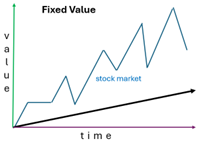
A safe, known return rate offered by banks. The lowest-performing option — typically 1–4% APY — that struggles to keep pace with inflation. It is entirely predictable, which is why 80% of people keep their money here. But predictability at 1–2% is not a feature when inflation runs at 3%; it is a slow loss of purchasing power.
Fixed interest is appropriate for emergency funds and short-term needs. For long-term wealth building, it is the least effective option available. See Future Value & Inflation for the math on why.
Variable Interest
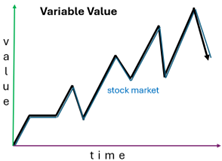
A volatile method involving stock market participation. Variable investments carry significant risk — the value of the investment can decline substantially in a bad market year. Best suited for long-term investors who can ride out downturns and do not need to draw income during periods of loss.
Average market loss during the 2008 financial crisis, caused by the collapse of the U.S. housing market. It took America approximately 8 years to fully recover those losses. A retiree drawing income in 2008 from a variable account would have faced devastating consequences — the combination of market losses and withdrawals creating a hole that may never have recovered.
Indexed Interest

A strategy where money is linked to the performance of a market index — such as the S&P 500 — but protected by a floor that ensures the investment value never goes down due to market downturns. In years when the index gains, the account is credited with a portion of those gains (up to a cap). In years when the index loses, the account credits zero — not negative.
Warren Buffett, one of history’s most successful investors, is a prominent advocate of index instruments for this very reason: capturing market growth without full market risk.
The key insight: Indexed products lock in gains permanently. When the market drops, previously credited gains are not lost — the floor holds. This uninterrupted compounding, combined with market-linked upside, is why indexed products consistently outperform both fixed and variable options over long time horizons for the informed investor.
Side-by-Side Comparison
| Attribute | Fixed | Variable | Indexed |
|---|---|---|---|
| Typical APY | 1–4% | Market-dependent | Market-linked (capped) |
| Protected from market losses | ✓ Yes | ✕ No | ✓ Yes (floor) |
| Participates in market gains | ✕ No | ✓ Yes | ✓ Yes (capped) |
| Keeps pace with inflation | Often not | In good years | Typically yes |
| Predictable return | ✓ Yes | ✕ No | Partially |
| Safe for retirement income | Limited growth | Risk in down years | ✓ Yes |
| Used by what % of Americans | 80% | 15% | 5% (mostly wealthy) |
The opportunity: Most Americans unknowingly leave significant growth on the table by keeping 80% of their money in fixed-rate products that barely keep pace with inflation — while the wealthy quietly use indexed instruments that grow with the market without the downside. Contact us to explore indexed strategies appropriate for your situation.